
Exciting legislative developments in the Lone Star State offer new tools to prosecutors and stronger protections for property owners.
By Adam Mohrbacher
For most homeowners, a deed represents safety, stability, and legacy. Deed fraud turns that certainty upside down. With just a handful of fraudulent filings, criminals can trigger months—sometimes years—of financial and legal turmoil for unsuspecting owners. This crime is growing rapidly and poses a serious threat to the real estate and title industries, often leaving lasting damage in its wake. “Deed fraud is a very real threat,” said Rodney Anderson, EVP and National Agency Manager at Alliant National. “It’s about someone’s home, their family’s legacy, and sometimes their entire life’s savings. That’s why the legislation recently passed by the Texas Legislature—shaped with critical input from organizations like the Texas Land Title Association (TLTA)—is so important.”
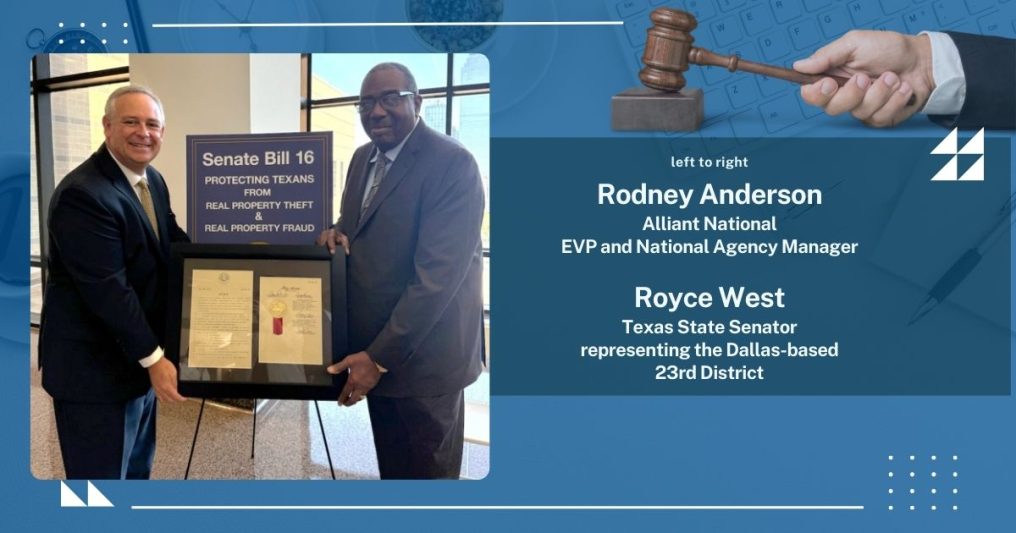
Anderson is referring in part to Senate Bill 16 (SB 16), which significantly strengthens prosecutors’ ability to pursue deed fraud cases. SB 16 is a cornerstone of a broader legislative package designed to attack deed fraud from multiple angles. Led by State Senator Royce West, the effort positions Texas as a national leader in confronting this urgent and complex issue. “Together, these bills create the strongest state-level protections against deed fraud and title theft anywhere in the country,” Senator West said upon their signing.
An Easy Crime with Devastating Consequences
Legislative action was necessary because deed fraud is not only destructive. It is also often disturbingly easy to commit. One scheme fraudsters use involves falsified documents transferring ownership into their name or an entity they control. They frequently target raw land, vacant properties, and deceased or elderly property owners. Once the fraudulent conveyance is recorded, they “sell” the property, disappearing long before the real owner realizes the damage that has been done.
This scheme and others like it succeed by exploiting weaknesses in document notarization and recording processes, as well as challenges within the legal system. While Texas law already required notaries to verify signatures, inconsistent compliance and limited accountability left openings for fraud and abuse. County clerks, meanwhile, are tasked with processing documents efficiently, not investigating their authenticity. In many cases, victims don’t discover fraud until they try to legitimately sell or refinance their property. And even then, the ordeal is far from over. “The cleanup process can be brutal,” Anderson explained. “Proving a deed is fraudulent usually requires formal legal action, and that process is expensive and time-consuming.”
Historically, prosecutors have been hesitant to pursue these cases criminally, not due to lack of concern, but like most states, Texas lacked statutes tailored specifically to deed fraud. Prosecutors were forced to rely on general theft statutes, attempting to fit complex title crimes into legal arguments that simply weren’t designed for this kind of crime.
A Comprehensive Legislative Response
The Texas Legislature addressed these gaps with a four-bill package that reforms the system holistically. The measures strengthen prevention, improve detection, empower victims, and equip prosecutors with felony statutes that reflect deed fraud’s complex reality.
Key provisions include:
- Senate Bill 16
Creates two new criminal offenses specifically addressing real property theft and real property fraud, giving prosecutors statutes that align with how deed fraud schemes operate. “These laws send a clear message that Texas is serious about detecting, prosecuting, and deterring deed fraud,” said Anderson. “They won’t stop every bad actor, but they make fraud harder to commit, easier to detect, and faster to unwind without overburdening legitimate transactions.”
- Senate Bill 647
Requires county clerks to notify the grantor, grantee, and most recent property owner if a lien appears fraudulent. It also allows clerks to request supporting documentation, seek district attorney assistance, and refuse filing if certain documentation is not provided.
- Senate Bill 693
Targets notary reform by criminalizing notarization without a signer’s presence and establishing continuing education requirements through the Secretary of State. The goal is to raise professional standards and accountability among notaries.
- Senate Bill 1734
Allows property owners who believe a recorded conveyance is fraudulent to file an owner’s affidavit. If no controverting affidavit is filed, the owner may petition for district court for an expedited review.
The Power of Collaboration
This legislative success underscores the power of collaboration. It was made possible by lawmakers, regulators, law enforcement, county officials, and industry leaders working toward a shared goal. Senator West led the charge, with key contributions from State Representative Rafael Anchia in the Texas House. Coordination with the County Clerk’s Association, the Dallas District Attorney’s office, and John Warren, the Dallas County Clerk, was critical along with input from the Texas Land Title Association. “TLTA’s advocacy on this issue demonstrated exactly why all Texas title agents should be a member of the association,” said Anderson, a former legislator, past TLTA president and current committee chair. “TLTA Vice President of Government Relations and Counsel, Aaron Day, led the advocacy efforts with substantial input from both the Regulatory and Legislative Committees, and with approval from the TLTA Board of Directors.”
A Model for the Nation
The Texas deed fraud package represents a meaningful victory for property owners and the real estate industry alike. It strengthens notary standards, supports county clerks, empowers victims, and gives prosecutors the tools they need to pursue justice. Just as importantly, it offers a roadmap that other states can follow. “This legislation should be used as a model throughout the country,” Anderson said. “Land title associations can partner with lawmakers, prosecutors, and public officials to reduce deed fraud. No law is perfect, but if collaboration leads to legislation that protects families—or helps owners reclaim property faster—then it’s absolutely worth the effort.”